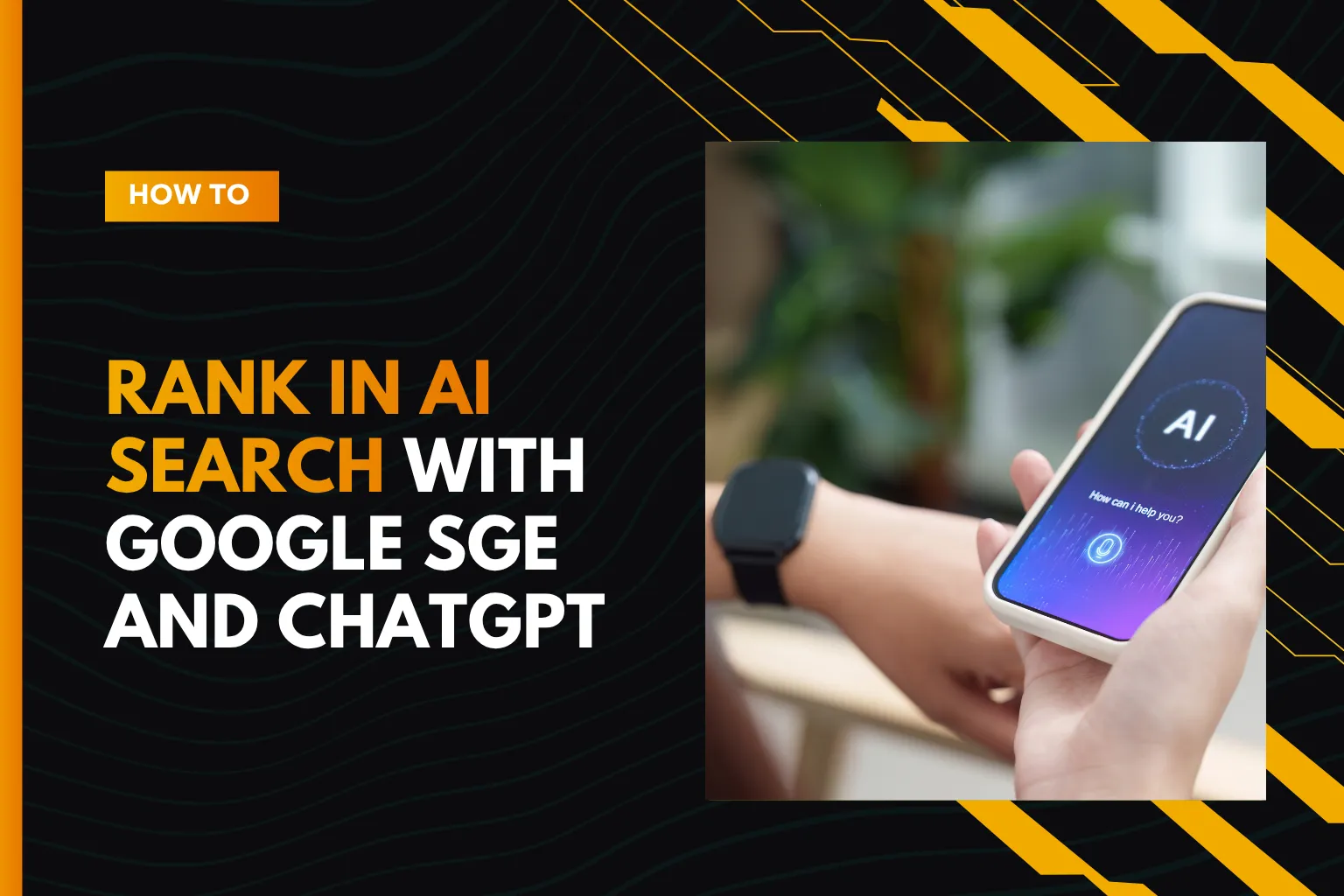
AI search is changing how people find businesses, compare services, and make decisions.
A few years ago, most search journeys followed a familiar pattern. Someone searched on Google, scanned the results page, clicked a few websites, and chose the business that looked most relevant. That still happens, but it is no longer the full picture.
Today, people ask tools like ChatGPT, Perplexity, Gemini, Claude, Microsoft Copilot, and Google’s AI features to explain topics, compare brands, recommend providers, and summarise options. Google’s AI Overviews now provide AI-generated snapshots with links for users to explore more on the web, and Google says AI Overviews are available in more than 120 countries and territories.
That means your website is not only competing for a blue link on Google. Your brand is also competing to be mentioned, cited, summarised, trusted, and recommended by AI search engines.
This is where Generative Engine Optimisation, or GEO, comes in.
Generative Engine Optimisation is the process of improving your website, content, brand signals, and digital footprint so AI search engines can understand your business, trust your information, and include your brand in AI-generated answers.
For a business, this is important because AI search can influence a buyer before they ever visit your website. If someone asks, “Who are the best SEO agencies for startups in the UK?” or “Which agency can help with AI SEO and AEO?”, your brand needs to be visible in the sources AI tools use to form their answers.
In simple terms, SEO helps your website rank higher in search results. GEO helps your brand get found in AI-generated answers. And in 2026, you need both.
In this blog post, we’ll explain to you the ways to get your brand found in AI search engines.
What is Generative Engine Optimisation and how does it work?
Generative Engine Optimisation is a search strategy focused on increasing your visibility inside AI-generated answers.
Traditional SEO improves your chances of ranking in search engines such as Google and Bing. GEO improves your chances of being referenced by AI search platforms, including Google AI Overviews, ChatGPT, Perplexity, Gemini, Claude, and Copilot.
The idea gained wider recognition after researchers introduced GEO as a framework for improving content visibility in generative engines. Their paper describes GEO as a way to help content creators improve how their content is represented and shown in AI-powered search systems.
In practical terms, GEO helps AI systems understand five things about your brand:
- What do you do?
- Who do you help?
- Where your expertise sits.
- Which sources support your claims?
- Why your content is reliable enough to cite or recommend.
This is why vague website content struggles in AI search. If your service page says, “We help brands grow with innovative digital solutions,” an AI engine has very little useful information to extract. It cannot clearly understand your services, audience, proof, or expertise.
A stronger version would say:
“YellowInk helps startups and small businesses improve visibility across Google, AI search engines, and answer platforms through SEO, AI SEO, AEO, GEO, content strategy, technical SEO, and website optimisation.”
That gives AI systems clearer information. It tells them what the company does, who it helps, and which search areas it covers.
GEO works best when your content is clear, structured, factual, well-sourced, and supported by wider brand signals across the web.
How is GEO different from traditional SEO?
GEO and SEO are connected, but they are not the same.
Traditional SEO focuses on getting your pages crawled, indexed, ranked, and clicked in search results. It uses keyword research, technical SEO, backlinks, content quality, internal linking, page speed, metadata, and search intent.
GEO goes further. It asks whether AI systems can understand your content well enough to use it in an answer.
A traditional SEO strategy may focus on ranking a blog for “what is AI SEO”. A GEO strategy asks whether that blog gives a clear definition, answers related questions, includes supporting data, cites credible sources, explains the concept better than competitors, and gives AI tools enough reason to mention the brand.
The difference matters because an AI search does not always work like a standard search results page. Instead of giving users 10 links, AI tools often create a single answer by combining information from several sources.
So the question changes.
In traditional SEO, you ask: “Can we rank for this keyword?”
For GEO, you ask: can an AI search engine understand, trust, and use our content in its answer?
That shift changes how you write.
You need direct answers, clear headings, structured explanations, strong examples, external references, author credibility, and proof. You also need brand mentions beyond your own website because AI tools may look at reviews, directories, forums, social platforms, news articles, partner pages, and trusted third-party sources.
GEO does not replace SEO. It builds on it.
Without good SEO foundations, GEO becomes much harder.
Read More: 10 Ways to Optimise Your Website for AI Agents in 2026
Why does GEO matter for businesses in 2026?
GEO matters because AI search is no longer a side trend. It is becoming part of the normal search journey.
Gartner predicted that traditional search engine volume would drop by 25% by 2026 as users shift towards AI chatbots and virtual agents. BrightEdge also reported in February 2026 that AI Overviews now trigger for nearly half of all tracked queries, while noting that organic search still accounts for most search activity.
That second point is important.
AI search is growing, but organic search is not dead. The smartest strategy is not to abandon SEO. It is to improve SEO so your content performs across both traditional search and AI-led discovery.
For businesses, GEO matters for three reasons.
First, AI search can reduce clicks. If an AI Overview provides the user with enough information, they may click fewer websites. That means your brand needs to be visible inside the answer itself, not only below it.
Second, AI search shapes trust. If AI tools mention your competitors but ignore your brand, users may assume those competitors are more established.
Third, AI search affects high-intent decisions. Buyers may use AI tools to compare agencies, find local providers, shortlist software, research suppliers, or understand which business fits their needs.
If your brand is missing from those answers, you are absent from an important part of the buying journey.
How do AI search engines choose and display information?
AI search engines use different systems, but they usually favour content that is clear, relevant, trusted, and easy to extract.
Google explains that AI Overviews use generative AI to provide key information about a topic or question, with links so users can explore more on the web. Perplexity often shows inline citations. ChatGPT can cite sources when search or browsing is active. Copilot can summarise information with sources. Gemini and Claude may use a mix of model knowledge, web access, and connected sources depending on the setup.
The formats differ, but the core requirement remains the same.
AI systems need content they can understand.
That means your pages should avoid unclear claims, bloated introductions, missing sources, messy structure, and unsupported statistics. They should answer questions directly, use clear headings, explain the topic fully, and include credible references whenever factual claims are made.
AI systems also look beyond one page. They may consider whether your brand appears on trusted websites, in directories, in reviews, on social platforms, and in expert sources.
This is why GEO is both on-page and off-page.
Your website needs strong content. Your broader digital footprint should support it.
How can you write content that gets cited in AI search?
The first rule is simple: answer the question clearly.
If the section asks, “What is GEO?”, the first few lines should define GEO directly. Do not start with three paragraphs of scene-setting before the answer appears. AI systems and human readers both prefer clarity.
A strong answer looks like this:
Generative Engine Optimisation is the process of improving your content, website structure, and brand signals so AI search engines can understand, trust, cite, and recommend your business in AI-generated answers.
That answer works because it is complete, direct, and easy to extract.
After the direct answer, you can add depth. Explain how GEO works, where it applies, which platforms matter, and how businesses can implement it.
This structure is powerful because it serves two audiences at once. It helps AI engines extract a clean answer, and it helps readers understand the subject without wading through fluff.
You should use this approach across your website. Service pages, blogs, FAQs, case studies, and guides should all give direct answers before expanding into detail.
How should you structure your website for GEO?
Your website structure should make information easy to find, read, and understand.
Start with a clear H1 that describes the page’s main topic. Use H2s to answer the main questions users ask. Use H3s to break down supporting points.
This matters because AI systems use headings to understand the relationship between topics. A messy page with weak headings makes extraction harder.
For example, a strong GEO blog may include H2s such as:
- “What is Generative Engine Optimisation?”
- “How is GEO different from SEO?”
- “Why does GEO matter in 2026?”
- “How can businesses optimise content for AI search?”
- “How can you measure GEO performance?”
Each heading answers a real search question. Each section gives AI systems a clear content block to understand.
Your website should also use clean internal linking. If you mention AI SEO, link to your AI SEO service page. If you mention AEO, link to your Answer Engine Optimisation page. If you mention technical SEO, link to your SEO audit or consulting page.
Internal links help users move through your website. They also help search engines and AI systems understand how your topics connect.
How can schema markup help your brand appear in AI search?
Schema markup gives search engines structured information about your website.
It helps identify your business, services, products, authors, FAQs, reviews, articles, local details, and breadcrumbs. It does not guarantee AI citations, but it gives machines cleaner signals.
For GEO, useful schema types include Organisation, LocalBusiness, Article, FAQPage, Service, Product, Review, Person, and BreadcrumbList.
For YellowInk Digital, this may include schema for SEO services, AI SEO services, GEO services, AEO services, local business information, service pages, blog posts, author details, and FAQs.
Schema works best when it supports strong, visible content. Do not add schema for information that does not exist on the page. Search engines expect structured data to match what users can see.
Think of a schema as a label system.
The content is still the product. A schema helps machines understand what they are looking at.
How can trusted sources and citations improve GEO performance?
AI search engines are more likely to trust content that supports important claims with credible sources.
If your content includes statistics, platform changes, industry trends, or technical claims, cite reliable references. Good sources include official Google documentation, government websites, research papers, recognised industry bodies, credible research firms, and respected publications.
For example, if you write about AI Overviews, use Google as a source. If you mention the shift in search behaviour, use Gartner or another recognised research source. If you explain GEO as an academic concept, cite the original research paper.
This helps your content in two ways.
First, it builds trust with readers. They can see that your claims are not pulled from thin air.
Second, it gives AI systems clearer evidence. AI-generated answers often prefer information that can be verified.
The old way of writing SEO content often relied on broad claims. GEO needs better discipline.
If you cannot support a claim, rewrite it or remove it.
How can E-E-A-T improve visibility in AI search?
E-E-A-T stands for Experience, Expertise, Authoritativeness, and Trustworthiness.
It matters because AI search engines need to decide which sources deserve attention. This is especially important for topics that influence health, finance, legal decisions, safety, or major business choices.
Your content should show who wrote it, why they understand the topic, when it was updated, and which sources support it.
For a business like YellowInk Digital, E-E-A-T can come through founder-led insight, client case studies, measurable results, clear author bios, detailed service pages, examples from real projects, and transparent company information.
Your website should not feel anonymous.
If you claim to help businesses with AI SEO, AEO, and GEO, show how. Explain your process. Show your case studies. Share the types of audits you run. Mention the platforms you optimise for. Explain how you track AI visibility.
Trust is not built through big words. It is built through clarity, proof, and consistency.
How can FAQs help your website rank in AI answers?
FAQs are useful because AI search is conversational.
People ask AI tools complete questions, such as:
- “What is GEO?”
- “How do I get my brand mentioned in ChatGPT?”
- “Can small businesses appear in AI search?”
- “What is the difference between SEO, AEO, and GEO?”
- “Does schema help with AI search?”
Your content should answer these questions naturally.
A good FAQ answer should give the answer first, then add a short explanation. It should not ramble. It should not dodge the question. It should not sound like a sales pitch wearing a fake moustache.
FAQs also help you cover related search intent without overloading the main article. They make your page easier to scan and easier for AI systems to extract information from.
For GEO, every major blog or service page should include useful FAQs based on real customer questions, Search Console queries, sales calls, support emails, and competitor research.
How can off-page mentions help your brand get found in AI search?
Your website is only one part of GEO.
AI tools may also learn about your brand from other places, including business directories, review platforms, LinkedIn, Reddit, forums, podcasts, YouTube, partner websites, press mentions, and industry articles.
This makes off-page visibility more important.
If your brand appears across trusted sources with consistent information, AI systems have more confidence in who you are and what you do.
For example, an SEO agency that appears only on its own website may look less established than one that is also mentioned in case studies, business directories, Google Business Profile, LinkedIn, client websites, reviews, and expert articles.
Google has also recently updated AI Mode and AI Overviews to help users find websites, public discussions, authentic voices, and original content from across the web.
That matters because user-generated content, reviews, public discussions, and third-party mentions can influence how AI search understands reputation.
Your GEO strategy should include brand mentions, citations, backlinks, reviews, and external proof.
How can you measure whether your brand appears in AI search?
GEO measurement is still developing, so you need a practical mix of checks.
Start by testing your brand across AI search platforms. Ask ChatGPT, Perplexity, Gemini, Claude, Copilot, and Google AI features questions your audience would ask.
For example:
- “Which agencies offer AI SEO services in the UK?”
- “What are the best digital marketing agencies for startups?”
- “Who can help with AEO and GEO?”
- “What is YellowInk Digital known for?”
- “Which UK agencies help businesses appear in AI search?”
Then check whether your brand appears, how it is described, and whether the information is accurate.
You should also track AI referral traffic where available, Google Search Console impressions, organic conversions, branded search growth, AI Overview appearances through specialist tools, third-party mentions, and changes in rankings for question-led queries.
Do not measure GEO only by clicks.
AI search can influence a buyer before a click happens. A mention inside an AI answer can build trust even if the analytics path is messy.
In 2026, search performance needs to include visibility, citations, mentions, brand accuracy, and assisted conversions.
What mistakes should you avoid when optimising for AI search?
The biggest mistake is treating GEO as a quick technical trick.
GEO is not about adding a few FAQs and hoping ChatGPT suddenly crowns your brand king of the internet. Nice dream. Not how it works.
Avoid thin content. Avoid unsupported statistics. Avoid vague service pages. Avoid outdated platform names. Avoid publishing AI-written content with no expert input. Avoid making claims without examples or proof.
Also, avoid hiding key information inside images, videos, PDFs, or design elements that machines may struggle to read. Your important content should appear in clean, crawlable HTML wherever possible.
Another common mistake is ignoring off-page signals. If your website says one thing but your Google Business Profile, directories, reviews, and social profiles say something else, you create confusion.
AI search rewards consistency.
Your website, brand mentions, reviews, service pages, schema, and citations should tell the same story.
How can YellowInk help your brand get cited in AI search?
At YellowInk, we help businesses improve visibility across traditional search and AI-led discovery.
Our SEO services include AI SEO, AEO, GEO, technical SEO, content strategy, local SEO, service page optimisation, schema implementation, and AI search readiness.
We start by reviewing your current website and search visibility. We look at your technical SEO, page structure, service pages, content depth, internal links, schema, FAQs, Google Business Profile, backlinks, citations, reviews, and brand mentions.
Then we assess your AI search visibility. We check how your brand appears across platforms such as Google AI Overviews, ChatGPT, Perplexity, Gemini, Claude, and Copilot. We look at whether your business is mentioned, whether the description is accurate, which competitors appear instead, and what content gaps are holding you back.
From there, we build a practical SEO roadmap.
For some clients, that means rewriting vague service pages into clearer, AI-readable pages. For others, it means building topic clusters, adding FAQ sections, improving schema, creating stronger case studies, earning better citations, strengthening local business signals, or publishing content that answers high-intent questions.
We also help businesses build the right proof.
AI search engines need clear evidence. That means better case studies, stronger testimonials, accurate business information, external references, review signals, and content that explains your services in a way both humans and machines can understand.
Our goal is to help your brand become easier to find, easier to trust, and easier to cite across Google and AI search engines. Schedule a discovery call with one of our GEO experts to see how we can help your business to grow in 2026.
Final Thoughts
Generative Engine Optimisation is not a replacement for SEO. It is the next layer of search visibility.
Traditional SEO helps your website rank. AEO helps your content answer direct questions. GEO helps your brand appear inside AI-generated answers. Agentic SEO prepares your website for AI agents that may compare, recommend, and act on behalf of users.
In 2026, your brand needs to be visible across all of these search journeys.
That means your content must be clear, structured, accurate, well-sourced, and useful. Your website must be technically sound. Your service pages must explain what you do without hiding behind vague claims. Your FAQs must answer real questions. Your case studies must show proof. Your schema must support your content. Your external mentions must reinforce your authority.
The brands that win in AI search will not be the ones chasing every new tool. They will be the ones building trustworthy, useful, well-structured content that AI systems can understand and users can rely on.
Search is becoming more conversational, more answer-led, and more selective. Your job is to make sure your brand is not invisible when those answers are generated.
Most Common Questions
What is Generative Engine Optimisation?
Generative Engine Optimisation, or GEO, is the process of improving your website, content, and brand signals so AI search engines can understand, trust, cite, and recommend your business in AI-generated answers.
Is GEO the same as SEO?
SEO focuses on ranking in traditional search results. GEO focuses on visibility inside AI-generated answers from platforms such as Google AI Overviews, ChatGPT, Perplexity, Gemini, Claude, and Copilot.
Does GEO replace SEO?
GEO supports SEO. You still need technical SEO, content quality, backlinks, internal links, page speed, and a strong website structure. GEO adds another layer focused on AI visibility, citations, and answer extraction.
How do I get my brand mentioned in AI search?
You need clear service pages, strong topic depth, trusted sources, schema markup, useful FAQs, case studies, consistent business information, reviews, backlinks, and third-party brand mentions. AI tools need enough evidence to understand and trust your brand.
Can small businesses appear in AI search?
Small businesses can improve AI search visibility by creating clear service pages, answering specific customer questions, building local citations, improving Google Business Profile, earning reviews, adding schema, and publishing expert-led content.
What is the difference between GEO and AEO?
AEO, or Answer Engine Optimisation, focuses on answering direct questions clearly. GEO focuses on being included in AI-generated answers from generative platforms. They overlap because clear answers are important for both.
What is the difference between GEO and Agentic SEO?
GEO helps your brand appear in AI-generated answers. Agentic SEO prepares your website for AI agents that may read, compare, recommend, and take action on behalf of users, such as booking a call or submitting a form.
How can YellowInk help with AI search visibility?
YellowInk helps businesses with AI SEO, AEO, GEO, technical SEO, content strategy, schema, local SEO, service page optimisation, and AI search visibility tracking. We help your brand become easier for Google and AI search engines to understand, trust, and cite.